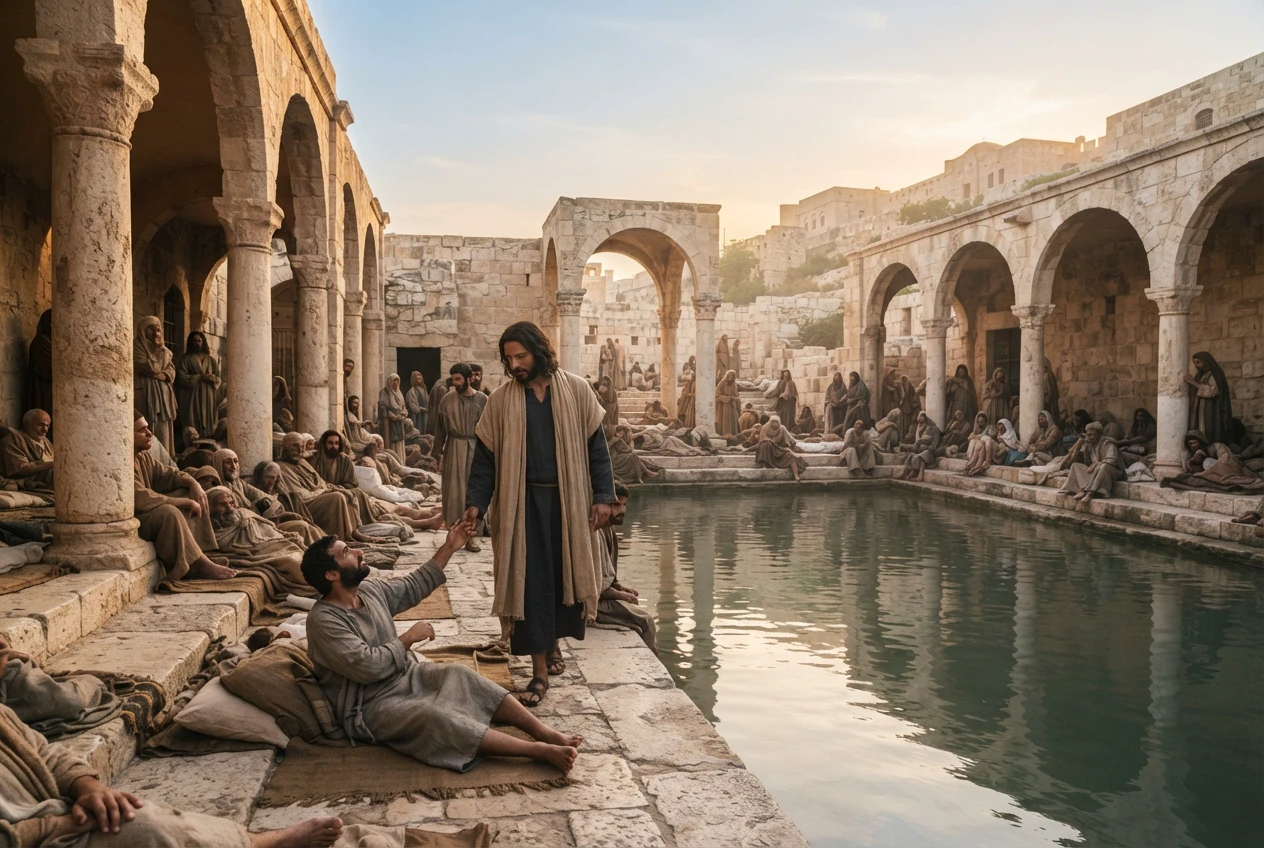
The Pool of Bethesda
The Five Most Important Questions Jesus Asked
The fifth most important question Jesus asked
Do You Want to Get Well?
Tap Listen, then keep walking — the song follows you from page to page.
Passage · John 5:1–14
Jerusalem · from The One
After these things, there was a feast of the Jews, and Jesus went up to Jerusalem.
In Jerusalem by the sheep market, there’s a pool, which in Hebrew is called, “Bethesda,” having five porches. In these lay many sick people—blind, lame, or paralyzed, waiting for the moving of the water, for an angel entered the pool at certain times and stirred the water. Whoever stepped in first, after the stirring of the water, was healed of their disease.
A man was there who had been disabled for thirty-eight years. When Jesus saw him lying there, and knew He had been sick a long time, He asked him, “Do you want to be made well?”
The man replied, “Sir, I have no one to put me in the pool when the water is stirred. While I’m trying to get in, someone steps down before me.”
Jesus commanded him, “Rise up! Pick up your mat and walk.”
Immediately, the man was healed, picked up his bed and walked. Because it was a Sabbath, the Jews told the man, “Today is the Sabbath. It’s not lawful for you to carry your bed.”
He answered, “He who healed me said to me, ‘Take up your mat and walk.’”
“Who told you to pick up your mat and walk?” they demanded.
Because Jesus had disappeared into the crowd, the healed man didn’t know.
Afterward Jesus found him in the temple and warned him, “See, you’ve been healed. Stop sinning, or something worse may happen to you.”
“Do you want to be made well?”
Devotional
Bill Perkins
Jesus walks into a crowded courtyard in Jerusalem,
near the Pool of Bethesda—
a place where the sick, blind, and paralyzed gather,
hoping for healing.
One man has been there 38 years,
lying on a mat,
waiting for a miracle.
Like a tree rooted in stone,
he had grown into his mat.
And Jesus asks a question that seems out of place:
"Do you want to get well?"
He isn't asking for information.
He's awakening a long-buried desire—
a hope crushed by decades of disappointment.
The man doesn't say yes.
He explains why he can't be healed.
No one helps him.
Others get there first.
His identity has fused with his condition.
He's not just sick—
he's stuck.
Jesus doesn't ask about technique or theology.
He asks about desire.
Because healing isn't just physical—
it's personal.
And sometimes,
we don't want it as much as we think we do.
This question exposes the quiet comfort of dysfunction—
the way brokenness becomes familiar,
the way excuses feel safer than change.
Like a worn blanket,
brokenness becomes shelter.
Jesus doesn't shame the man.
He doesn't argue.
He simply asks—
and then commands:
"Get up. Pick up your mat and walk."
No stirring of the water.
No angelic intervention.
Just a question that cuts through resignation
like a blade through rope.
And here's what you might not know about Jesus:
He still asks this question.
To the spiritually numb.
To the emotionally exhausted.
To the believer stuck in disappointment.
It's not a test.
It's an invitation.
Do you want to get well?
Reflection Question
Where have I made peace with being stuck?
What This Means to Me
Jesus isn't asking
for a plan.
He's asking
for a yes.
The man
had been waiting thirty-eight years.
He knew how to wait.
But healing
is more than waiting —
it requires an answer.
“Do you want to get well”
really means
“Are you ready to leave the mat?”
Because the mat is familiar.
The mat is where people bring me food.
The mat is identity.
Getting well
means letting go
of who I've been in this stuck place
and stepping into who I might be.
His question
still walks through the Bethesda
of my ordinary life.
And He's still asking.
Discussion Questions
- 1What excuses have become familiar or comfortable?
- 2What would “picking up my mat” look like in my life?
- 3What desire is Jesus awakening in me today?
- 4What step of obedience is Jesus asking for?
Prayer
Father, You see where I've grown numb. But Jesus still asks: Do you want to get well. So I say yes.
He is the Servant King— exalted above every name.
I declare this in Jesus' name. Amen.