Post 177
The Source of Forgiveness
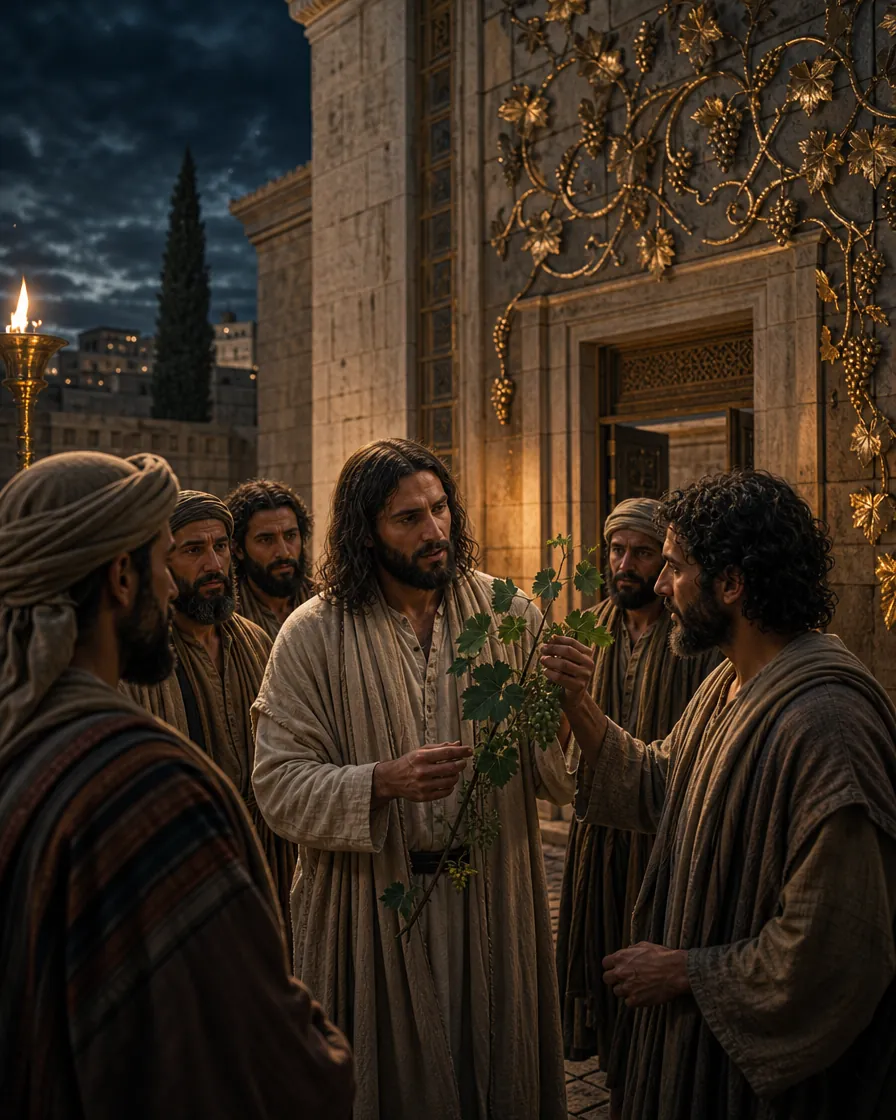
“Abide in Me, and I in you.” John 15:4
Forgiveness begins here.
Before Jesus ever speaks of releasing others,
He speaks of remaining in Him.
You may not know this about Jesus:
when He called Himself the Vine,
He stepped into Israel’s story-
a story where the vine
was the nation’s symbol,
planted by God
yet unable to bear the fruit
He desired.
A golden vine hung
over the entrance of the Temple,
its branches stretching across the facade,
its clusters donated by worshipers.
It was Israel’s identity in metal and light-
the reminder that they were God’s vineyard.
But the prophets told a harder truth:
the vine had withered.
It produced wild grapes (Isaiah 5),
turned degenerate (Jeremiah 2),
and stood fruitless before the nations (Ezekiel 15).
The vineyard God planted
could not bear the fruit God required.
Into that failed story Jesus speaks:
“I am the true vine.”
Not a new metaphor-
a fulfilled one.
He becomes the faithful Israel,
the living root,
the source of the fruit
the Father has always sought.
To abide is to remain.
It is the language of staying, not striving.
Jesus does not picture forgiveness
as something we manufacture,
but as fruit that grows
from a branch held in the true Vine.
The command is relational
before it is ethical.
Jesus does not say,
“Produce what I require,”
but “Stay where I place you.”
A branch does not create life.
It receives it.
It does not generate anything on its own.
It bears what the Vine supplies.
So it is with forgiveness.
We do not forgive because we are strong.
We forgive because His life
moves through ours.
The Father, the vinedresser,
tends the connection-
lifting, pruning, cleansing-
so the life of His Son
can flow without obstruction.
“Apart from Me you can do nothing” (John 15:5)
is not a warning but a description.
Nothing in the kingdom
grows from human effort.
Everything grows
from union with Christ.
Abiding is the posture
that makes forgiveness possible-
the quiet dependence
that lets His mercy
take shape in us.