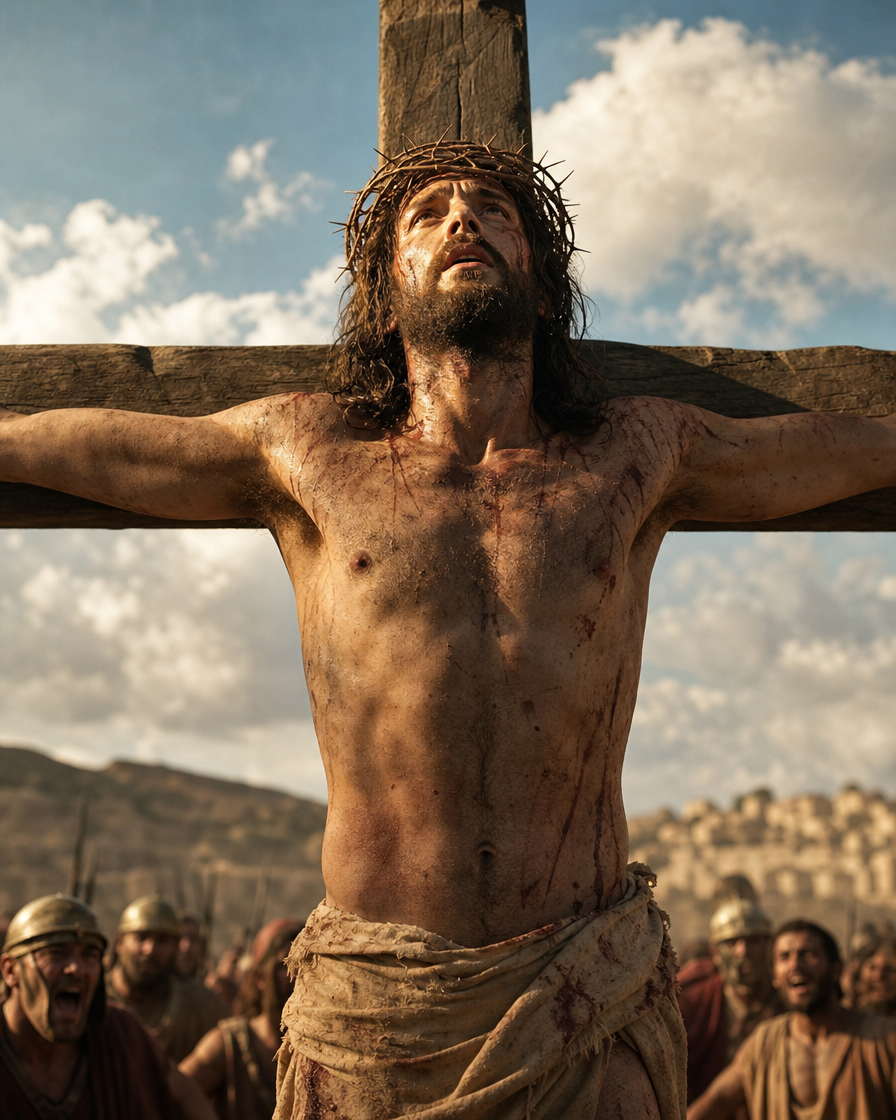
Jesus' First Word From the Cross
You May Not Know This About Jesus
Passover to Pentecost
"Father, forgive them,
for they don't know
what they're doing."
- Lu 23:34
He hung there-
suspended by nails
through His wrists and feet.
Soldiers laughing.
Leaders sneering.
The crowd mocking.
Both criminals
taunting Him
(Lu 23:39),
joining the chorus
of contempt.
His followers stood
at a distance-
far enough
not to be noticed,
but close enough
to see the hammer fall,
close enough
to hear His groans
and His last words.
He spoke seven times
from the cross.
Each sentence demanded
pushing down on His feet
to ease the weight
on His lungs.
His first prayer
from the cross
was spoken
in the present tense,
repeated
again and again:
"Father, forgive them."
To grasp the deeper meaning
of that prayer,
we must go back
to the garden.
It was there
Jesus' sweat mingled
with blood,
dripped to the ground-
from the cup
before Him.
On the cross,
His blood also dripped
to the ground-
from His hands,
His feet,
His head,
His back-
spilling from the cup
at His lips.
In Gethsemane (Mt 26),
Jesus prayed three times
for the Father
to intervene:
"Take this cup."
And the Father refused.
He held back
rescue.
At Golgotha (Lu 23),
on the cross,
Jesus repeatedly prayed
for the Father
not to intervene.
Here's the part
often missed:
the verb He uses
for forgive-
aphiemi-
usually means
release a debt.
"Forgive us our debts"
(Mt 6).
But aphiemi
also means:
hold back,
don't interfere.
And here,
it cannot mean
"cancel their debt."
Why?
Because forgiveness
never comes
because Jesus asks
the Father
to forgive someone.
Jesus said forgiveness comes
to the one who believes
in the One
the Father sent
(Jn 3; Jn 6).
On the cross,
Jesus can't be asking
the Father
to erase the debt
of His executioners.
There, aphiemi
must mean:
hold back,
don't interfere,
don't rescue Me.
Jesus isn't asking
for the forgiveness
of debt-
but pleading
for divine restraint.
So His prayer becomes
a plea for the Father
not to remove the cup.
Soon Jesus would
drink the cup
filled with
the Father's wrath.
You may not know this about Jesus:
He prayed for the cup to stay.
Forgiveness would come-
not because Jesus
prayed for it there,
but because
the Father let Him drink it.
Pass it on