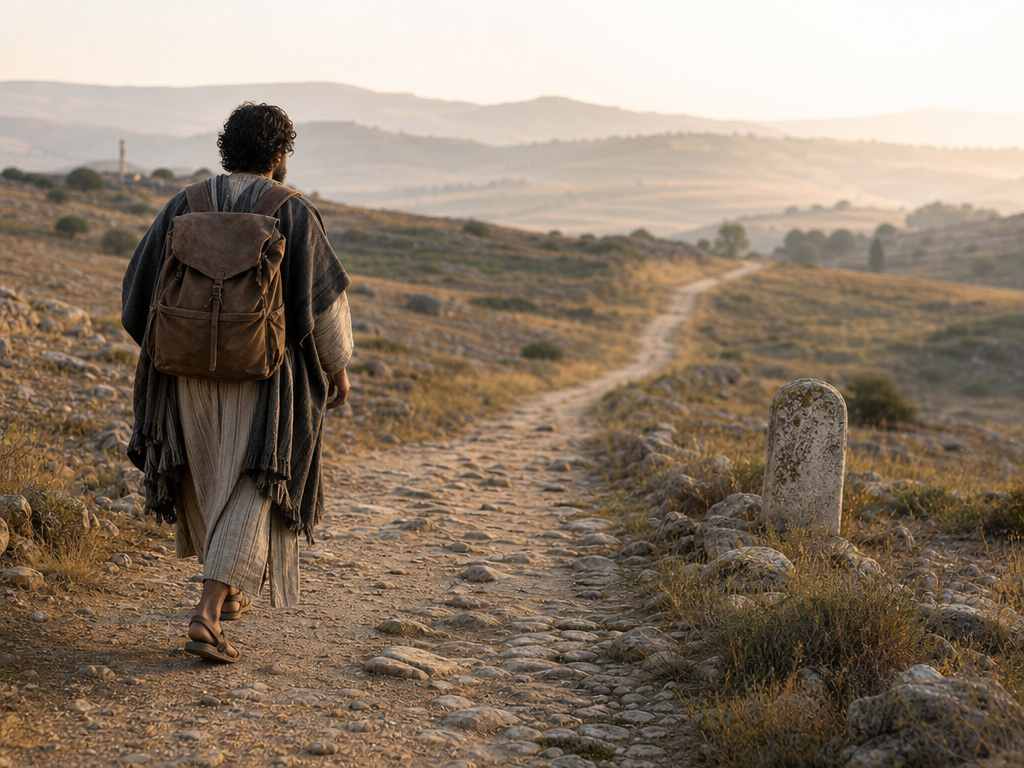
One Mile for the King
“If anyone forces you to go one mile, go with him two.”
— Matthew 5:41
You May Not Know This About Jesus
Sermon on the Mount
Being forced to carry
what you never chose
is humiliating.
In Jesus’ world, a Roman soldier
could command a civilian:
“Carry my pack.”
A soldier’s pack weighed 60–85 pounds.
Taxes drained families.
Crucified men often hung along public roads—
a brutal reminder
that resistance to Rome ended in death.
The soldier took your time.
Rome took your dignity.
The weak carried
what the powerful refused to bear.
Then Jesus steps onto the mountain
and offers a radical alternative:
“If anyone forces you to go one mile,
go with him two.”
Why?
Because the first mile belongs to the oppressor,
but the second belongs to your King.
By going further,
you reclaim your agency.
You are no longer acting
as a defeated subject of Rome,
but as an ambassador
of a higher Kingdom.
Rome could demand your body for one mile,
but your allegiance belonged to King Jesus.
You may not know this about Jesus,
but neither He nor His forerunner,
John the Baptist, ignored that abuse.
Jesus confronted it here
by overturning its power
in the second mile.
John confronted soldiers
who extorted money
or accused people falsely (Lk 3:14).
God’s Kingdom doesn’t excuse misused power.
It shows how to overpower it
with a freedom
the oppressor can’t command.
The first mile is forced.
The second is chosen.
And it isn’t approval,
weakness,
or surrender.
It’s moral freedom.
The soldier may command your feet,
but he can’t command your spirit.
He can take the first mile,
but the second isn’t his.
It’s offered freely—
a gift of the Kingdom
to a man worn down
by the weight he carries.
Jesus is teaching something bigger
than resistance.
He’s teaching
how to live with dignity
when someone abuses power.
How to bless
even those who abuse you.
The question isn’t only
what the aggressor makes you do.
It is whether he gets to decide
who you become.
The second mile reveals a freedom
the bully can’t command—
answering power
without pushing back,
protecting dignity
without surrendering kindness,
and living from a Kingdom
the oppressor can’t control.
Pass it on