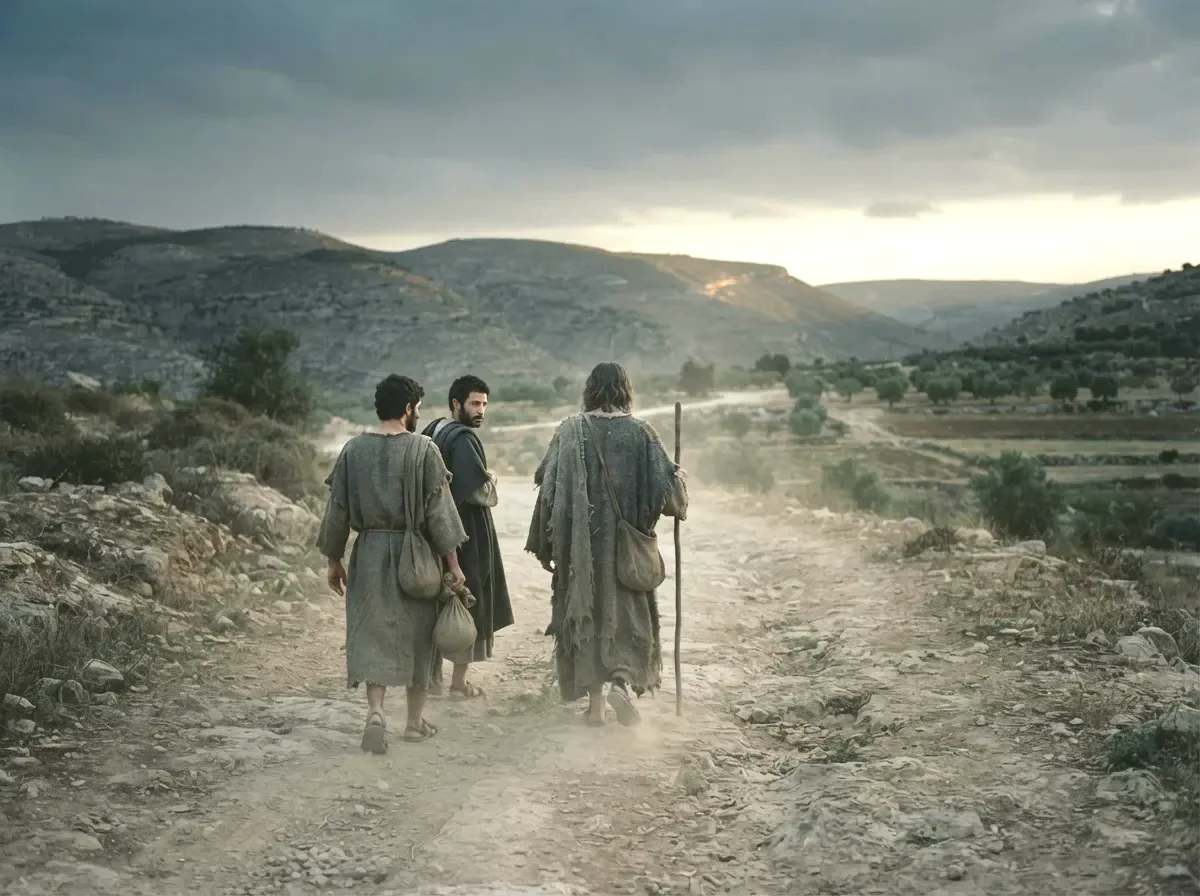
Jesus' First Invitation
“Behold, the Lamb of God”
— John 1:36
You May Not Know This About Jesus
Life of Jesus
"Come and see."
— John 1:39
John 1:35–39; John 15:4
Jesus turned and saw them following—
Andrew and the unnamed disciple.
Moments earlier they had been standing beside John the Baptist
when he pointed at Jesus and said,
"Behold, the Lamb of God" (John 1:36).
Jesus looked at them and asked,
"What are you looking for?" (John 1:38).
These are the first recorded words
He spoke to future disciples.
The English softens "looking for."
The Greek verb zēteō intensifies it.
It is pursuit.
It reveals desire,
direction,
intention.
It asks,
"What treasure are you chasing?
What is your life's pursuit?"
They answered with a question of their own:
"Rabbi, where are You staying?"
(John 1:38)
It's worth noting that John chooses the word menō—
to stay,
to dwell,
to remain,
to abide.
They were not asking for directions
or the name of His host.
They wanted to know where His presence could be found.
They were seeking an invitation to be with Him.
His reply: "Come and see" (John 1:39).
So they went—and they saw—for an entire day.
They stayed with Him—again, menō.
They shared His dwelling.
They shared His presence.
They shared His person.
John tells us almost nothing
about what happened in those hours.
The first disciple-making Jesus ever did
took place in secret.
But whatever passed between them in that hidden space
was alive, clarifying, unmistakably true—
because Andrew walked out convinced
and went straight to his brother.
What they could not have known
is that the very word they used that afternoon
would become the centerpiece of His final teaching.
On the last night of His life,
in John 15:4–10,
Jesus uses menō ten times
in just six verses.
The question that began,
"Where do You abide?"
becomes the command,
"Abide in Me, and I in you."
You may not know this about Jesus,
but His story begins with two disciples seeking His dwelling,
and ends with Jesus offering Himself
to dwell in them as they dwell in Him—
the way a branch abides in the vine.
Pass it on