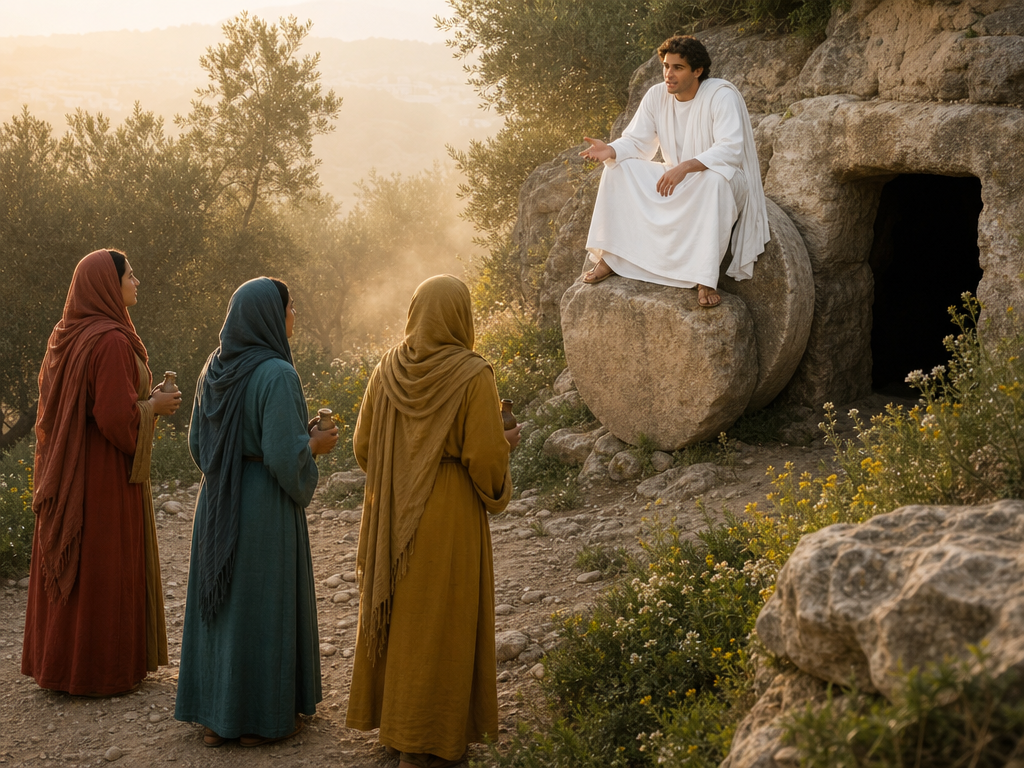
Why Was the Stone Removed?
“They saw that the stone had been rolled away, though it was very large.”
— Mk 16:4
You May Not Know This About Jesus
Passover to Pentecost
Before sunrise,
the women came to the tomb- (Mk 16:2)
Mary Magdalene,
Mary the mother of Joses,
and Salome.
They carried spices,
not hope.
The tomb was cut into limestone rock,
with a low entrance
you had to stoop to enter,
sealed by a heavy rolling stone,
set in a groove,
meant to stay shut.
As they walked through
the last shadows of night,
they asked:
"Who will roll away the stone for us?"
(Mk 16:3)
Stones like that weighed tons,
rolled downhill to close,
and took several men
to push uphill to open.
But when they arrived,
the stone was already moved (Mk 16:4).
Matthew gives the first clue:
an angel rolled it away
and sat on it (Mt 28:2).
Heaven turned a barrier
into a seat.
The first sign
that this empty sepulchre
is not a crime scene,
but an act of God.
The women stepped inside (Lu 24:3).
Two remained there,
staring at the vacant stone slab (Lu 24:3).
Mary saw it too,
and the shock sent her running (Jn 20:1-2).
Her first thought wasn't resurrection,
but loss, "They've taken Him."
So she raced to the disciples,
leaving the others inside.
And in the moment
we first hear of the empty tomb,
we're left with the same question
the women faced:
If Jesus isn't here,
what happened to His body?
No explanation given.
No understanding.
Just an empty place,
an angel on a stone,
and the quiet hint
that something greater
is unfolding.
You may not know this about Jesus,
but the stone wasn't moved
so He could get out.
It was moved so His disciples
could get in.
The open tomb
isn't an escape route.
It's an invitation.
Pass it on